
TL;DR
If your team spends on company money — travel, software, ads, subscriptions — and you're still chasing receipts and reimbursing personal cards, a business expense card with proper software wrapped around it will pay for itself fast.
Six names dominate the UK shortlist: Pleo, Soldo, Payhawk, Spendesk, Revolut Business, and Capital on Tap. They are not the same product. Pleo and Soldo are spend platforms with cards bolted on.
Payhawk and Spendesk go heavier on enterprise controls. Revolut Business is a multi-currency account that happens to issue cards. Capital on Tap is a credit card with a high limit. Pick by the problem you're trying to fix, not by who has the slickest landing page.
This guide walks through what these cards actually are, how the three main types differ, and how the six leading providers stack up on price, controls, FX, and accounting integrations — in May 2026 prices.
What is a business expense card?
A business expense card is a payment card you give to an employee so they can spend on company money without dipping into their own pocket. It looks like a normal Visa or Mastercard. The difference is the rails behind it: a dashboard for finance, spending rules per cardholder, real-time transaction feeds, and (on the better platforms) automatic receipt capture and a clean push into your accounting software.
That is the whole pitch. No more reimbursing the salesperson three weeks after a client dinner. No more "I lost the receipt" excuses. No more month-end where the FD reconstructs spend from a credit card statement and a pile of crumpled paper.
The three types of business cards (and which one you actually want)
Not every "business card" is the same product. The UK market has three flavours, and the difference matters.
Prepaid / company-issued spend cards. You load funds onto the card or wallet in advance. The cardholder can only spend what's been allocated. Soldo and Pleo (on most plans) work this way. The upside: tight control, no credit checks, no surprises. The downside: you have to keep wallets topped up.
Debit cards. Spend draws straight from your business current account. Monzo Business, Tide, and Revolut Business sit here. Simple to set up, but any misuse hits your operating balance immediately, and controls depend on what the bank's app supports.
Credit cards. A pre-agreed credit line, repaid monthly. Capital on Tap and American Express Business are the obvious UK examples. Useful if you want cash-flow flexibility or cashback. Less useful if you want fine-grained per-employee controls — most credit cards were not built for that.
A reasonable rule of thumb: if your problem is control and visibility, you want a prepaid spend card with software. If your problem is cash flow, you want credit. Plenty of finance teams run both.
What changed: software-led cards vs traditional bank cards
The card is the boring part. The reason teams switch to Pleo or Soldo or Payhawk isn't the plastic — it's everything that happens around the transaction.
A modern spend platform will:
- Stop an out-of-policy purchase before it happens (block specific merchant categories, cap per-transaction amounts, freeze a card from your phone)
- Push a notification to the employee at the moment of purchase, prompting them to snap the receipt
- Code the VAT, attach the receipt, and sync the whole entry into Xero, QuickBooks, Sage, or NetSuite without anyone keying it in
- Show finance a live feed of company spend instead of a statement that lands two weeks after month-end
Compare that to a Barclays or HSBC business debit card, where you find out what was spent when the statement arrives. The card is the same; the system around it is the difference. HMRC accepts digital receipts provided they're complete and stored for six years, which is what these platforms are built to do.
Top 6 business expense card providers in the UK: comparison table
| Provider | Card type | UK pricing (entry) | FX fees | Best for |
|---|---|---|---|---|
| Pleo | Prepaid + virtual | Free Starter (3 users); Essential £45/mo | 1.49–2.49% above interbank | SMEs wanting clean UX and fast adoption |
| Soldo | Prepaid Mastercard | Plans from ~£21/mo + per-card fees | ~2% on FX | Teams needing granular budget controls |
| Payhawk | Corporate + AP | Custom pricing only | Multi-currency, low-fee | Larger SMEs and enterprises with ERP needs |
| Spendesk | Hybrid spend platform | Custom pricing only | Multi-currency wallets | Finance teams wanting AP + cards in one |
| Revolut Business | Multi-currency debit | Free Basic; Grow £19/mo | Free at interbank up to plan limit | Cross-border spend, freelancers, small teams |
| Capital on Tap | Business credit card | No subscription; rep APR ~30%+ | 0% foreign transaction fees | SMEs wanting credit + 1% cashback |
Pricing is list pricing on each provider's UK site as of May 2026. Most platforms negotiate on annual contracts and at scale; the published numbers are a starting point, not a ceiling. Check current pricing before you sign — these things move.
The six providers, in detail
1. Pleo
The default recommendation for UK SMEs in the 5–100 employee bracket. Pleo gives every cardholder a physical or virtual Mastercard, prompts them for a receipt at the point of purchase, and pushes the coded transaction into Xero, QuickBooks, Sage, or NetSuite. The mobile app is the cleanest in the category, which matters because if your team won't use it, none of the controls help.
Pricing is per-user. The Starter plan is free for up to three users; Essential is £45/month, Advanced is £99/month, and Beyond is £199/month, with additional users priced from £15 to £18 each on the higher tiers. Cashback (0.5% on Advanced, 0.75% on Beyond) is capped at the subscription cost, so don't budget for it as savings. FX is 1.49–2.49% above interbank — fine for occasional travel, expensive if a big chunk of spend is in euros or dollars.
Best for: product-led SMEs that want speed of adoption and don't need ERP-level controls.
2. Soldo
Soldo is the other name that comes up in every UK shortlist. The pitch is granular control: prepaid Mastercard cards tied to wallets, with budgets ring-fenced by team, project, or vehicle. Useful if you want the marketing wallet separate from the travel wallet separate from the office-supplies wallet, with hard limits on each.
UK pricing starts around £21/month plus per-card fees on the Standard plan, scaling up with Plus and Premium tiers. FX runs around 2%. Integrations cover Xero, QuickBooks, NetSuite, and SAP Concur. The reporting is solid; the mobile app is functional rather than delightful. Worth knowing: Soldo restructured pricing from per-card to per-user, which annoyed some long-time customers, and several reviewers note that some of the better wallet-control features sit on higher tiers.
Best for: finance teams that need departmental sub-budgets and don't mind a slightly heavier admin overhead.
3. Payhawk
Payhawk is what you reach for when the SME tools start feeling thin. Corporate Visa cards, multi-currency accounts with local IBANs, deep approval workflows, and integrations with NetSuite, SAP, and Microsoft Dynamics. The product also covers AP automation and bill payments, so it's closer to a full spend platform than just a card.
Pricing is "contact us" only, which tells you what you need to know about the target market. Payhawk fits larger SMEs and enterprises operating across multiple entities or currencies, where the cost of the platform is small compared to the cost of finance team time it saves.
Best for: mid-market and enterprise finance teams with multi-entity, multi-currency complexity.
4. Spendesk
Spendesk is the French answer to Payhawk. A spend management platform with cards, AP, invoice management, and budgets, aimed at finance teams that want one tool instead of three. It's a strong fit for businesses where the bottleneck isn't card spend specifically — it's the wider mess of cards plus invoices plus reimbursements plus approvals.
Pricing is custom and tiered by company size. Spendesk skews towards mid-market businesses (50–500 employees) where finance has the headcount to drive an implementation but not the appetite for a full ERP rollout. Integrations cover Xero, QuickBooks, NetSuite, Datev, and Sage Intacct.
Best for: mid-market finance teams consolidating cards, invoices, and approvals.
5. Revolut Business
Revolut is the odd one out on this list because it's not a spend management platform — it's a multi-currency business account that happens to issue physical and virtual cards. But for plenty of UK SMEs, especially ones with cross-border spend, that's exactly what they need.
The Basic plan is free; Grow is £19/month; higher plans go up from there. You can hold balances in 25+ currencies, spend at the interbank rate from a matching balance (with monthly FX allowances on each plan), and issue up to 200 virtual cards per team member. Expense management features (receipt capture, approvals) are available on paid plans for an additional fee. The FX edge is real — if a third of your spend is in euros, Revolut's structural advantage over a Pleo or Soldo on FX adds up quickly.
Best for: small teams with international spend; freelancers and solopreneurs; anyone who values FX cost over deep expense controls.
6. Capital on Tap
The credit option. Capital on Tap is a UK business credit card from a UK lender, with credit limits up to £250,000 (subject to eligibility), unlimited free employee cards, 1% uncapped cashback, and no foreign transaction fees. There's no subscription cost — you pay through the credit interest if you don't clear the balance monthly.
The expense management is light compared to Pleo or Payhawk: you get the basics in the app and portal, with direct feeds into Xero and QuickBooks. If you want serious controls and policy enforcement, you'll pair Capital on Tap with a separate expense tool. If what you actually want is a credit line with cashback and clean accounting integration, this is one of the better cards in the UK market.
Best for: SMEs that want a credit facility, cashback, and broad employee-card distribution without per-user platform fees.
How to choose: a five-step shortlist
The right card is the one that solves your specific bottleneck. A quick framework:
1. Name the actual pain. "We're losing VAT on personal-card receipts" is a different problem from "We need a credit line for cash flow" is a different problem from "Our salesperson in Berlin keeps getting stung on FX." Different pains, different cards.
2. Decide whether you want control before or after the spend. Before-spend controls (limits, merchant blocks, pre-approval) need a spend platform — Pleo, Soldo, Payhawk, Spendesk. After-spend reconciliation can work with any debit or credit card plus expense software bolted on top.
3. Match the card to the use case. Virtual cards for SaaS subscriptions and ad spend (single-use, auto-expire). Physical cards for travel and on-site. Credit for cash flow. Most teams end up with two or three card types running in parallel.
4. Pressure-test HMRC and VAT. Whatever you pick must capture digital receipts, hold the VAT data as structured fields, and store everything for six years. Under Making Tax Digital you also need digital links between systems — no copy-paste from spreadsheets. Every provider in this list passes that test, but ask the question explicitly.
5. Cost the whole thing, not just the subscription. Per-user fees, FX margins, ATM fees, replacement card costs, and the time finance saves on month-end. The cheapest subscription often isn't the cheapest answer once you factor FX and admin time.
The hidden cost most finance teams miss: FX
Ask any finance director with international spend what their actual card cost is, and the subscription line is rarely the biggest one. FX margin — the spread your provider takes on every euro or dollar transaction — quietly eats more than the platform fee in most cases.
The chart below puts numbers on it. For a business spending £10,000 a year in foreign currencies, here's what the FX margin alone costs you across the six providers:
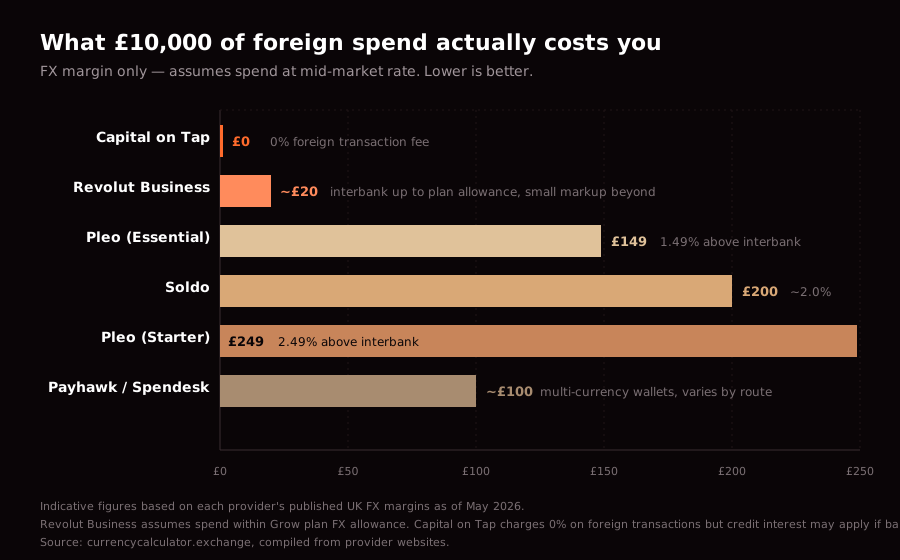
Three things jump out:
- Capital on Tap and Revolut Business structurally win on FX. Capital on Tap charges 0% foreign transaction fees outright; Revolut gives you interbank rates up to a generous monthly allowance.
- Pleo's 2.49% Starter rate is the highest line on the chart. Free up front, expensive in dollars.
- Soldo at ~2% sits in the middle — competitive on subscription, less competitive on FX.
If foreign spend is a meaningful share of your card volume, this chart is the comparison that matters more than the subscription price.
Quick check: want to see what a specific transaction would cost at the mid-market rate (the rate banks and providers benchmark against)? Use our free currency converter — no markup, no signup, just the live rate. Run a few of your real transactions through it, then compare against your card statement to see exactly what your provider is charging.
HMRC, VAT, and Making Tax Digital: what actually matters
A few non-negotiables for any business card you put company spend through:
- Digital receipts. HMRC accepts them, but they have to be legible, complete, and stored for six years. Apps that prompt for the receipt at the moment of purchase win on capture rate.
- VAT as a structured field. Not just a photo. The platform should pull the VAT amount, merchant, and date as data your accountant can query and reclaim.
- MTD-compatible accounting integration. If you're VAT-registered and over the threshold, your spend data has to flow into MTD-compatible software (Xero, QuickBooks, Sage, etc.) via "digital links" — no manual rekeying.
- Six-year retention. All receipts, all transactions, retained and searchable.
Every provider in this guide handles these to some standard. The differences are in how aggressively the platform enforces them — Pleo and Soldo will nag the cardholder until the receipt is captured; a bare Revolut Business or bank card will not.
FAQs
Are business expense cards tax deductible?
Spend on a business expense card is deductible if it's wholly and exclusively for business purposes — same rule as any other business expense. The card itself doesn't change the rules; what changes is how cleanly you can prove the spend was business, with digital receipts and VAT captured at source. Personal use of a business card creates a benefit-in-kind problem, so most platforms make policy enforcement easy.
Do I need a credit check to get one?
Depends on the type. Prepaid spend cards (Pleo, Soldo) and most debit options (Revolut Business, Tide) do not require a credit check on the business — you're spending your own money. Credit cards like Capital on Tap and American Express Business do require a credit check, and many will want a personal guarantee from a director.
What's the difference between an employee expense card and a corporate card?
Mostly marketing. "Employee expense card" usually means a prepaid or debit card issued to a non-director employee with a spending limit — Pleo, Soldo, and Tide all sit here. "Corporate card" usually implies a credit card issued to the business with employees as authorised users, with the business carrying the liability. The lines blur — Payhawk and Capital on Tap call their products corporate cards but operate quite differently.
Can I issue cards to contractors and freelancers?
Yes, on most platforms. Pleo, Soldo, Payhawk, and Revolut Business all let you issue cards to non-employees with the same controls. Useful for project-based work or external collaborators. Just be aware of the IR35 angle if the contractor is operating through a personal service company — issuing them a card with employee-style controls can muddy the status conversation.
How do FX fees work on UK business expense cards?
It varies a lot. Pleo charges 1.49–2.49% above interbank depending on plan. Soldo is around 2%. Capital on Tap charges 0% foreign transaction fees. Revolut Business gives interbank rates up to a monthly allowance, then a small markup. If a meaningful share of your spend is in euros or dollars, FX is often the biggest line item — bigger than the subscription. You can use a free mid-market currency converter to benchmark what your provider is actually charging on real transactions.
Which card should you actually pick?
A finance director with a 30-person team in London who travels occasionally is going to land on Pleo. A 200-person business with a Spanish subsidiary and German contractors is going to land on Payhawk or Spendesk. A two-person consultancy that bills in dollars and pounds is going to land on Revolut Business. A founder who wants £100k of working capital and 1% back is going to land on Capital on Tap. None of those choices is wrong.
The mistake is picking by brand recognition. Pleo and Soldo are the loudest names in the UK SME space, but Pleo's per-user pricing gets expensive at scale, and Soldo's wallet-heavy model is overkill for a small team that just wants cards. The right answer is the one that matches the problem you're trying to fix — not the one with the best billboard at Old Street.
If you spend a meaningful chunk of your card volume in foreign currencies, the FX margin on the card is usually a bigger number than the platform fee. Run your real transactions through our free currency converter at the mid-market rate, then compare against what your provider charged — that's the cleanest way to see what FX is actually costing you.
Pricing in this guide reflects each provider's published UK pricing as of May 2026. Plans, fees, and FX margins change — always check the provider's site before signing.