
TL;DR
In May 2026, the world's strongest currency is still the Kuwaiti dinar (KWD) at roughly $3.27 to the dollar. The top 10 also includes the Bahraini dinar, Omani rial, Jordanian dinar, British pound, Gibraltar pound, Swiss franc, Cayman Islands dollar, euro, and — surprisingly far down — the US dollar itself at number 10.
But the headline list is only part of the picture. A high exchange rate doesn't make a currency powerful. The US dollar is the most traded, most reserved, and most influential currency on Earth, and yet it's tenth on this list. The Kuwaiti dinar is number one, and outside Kuwait, almost nobody trades it.
This guide covers the full top 25 with live May 2026 rates, country profiles for each of the top 10, and the bits most lists skip — what "strong" actually means versus valuable, traded, stable, and powerful. Each of those is a different question with a different answer.
What "strongest currency" really means
Four ideas that get tangled up:
Value (exchange rate). This is what this list ranks. How many US dollars does one unit of a currency buy? One Kuwaiti dinar buys $3.27. One Indian rupee buys about $0.012. The dinar is "stronger" by value.
Stability. How much a currency moves over time. The Swiss franc is famously stable. The Turkish lira is not. Stability matters more to investors and treasurers than headline value.
Reserve and trade status. How much the currency is held by central banks and used in global trade. The US dollar dominates — roughly 58% of global reserves and one side of 88% of all forex trades, per the Bank for International Settlements Triennial Survey. The Kuwaiti dinar is a rounding error in both.
Liquidity. How easily the currency can be bought and sold without moving the market. The dollar, euro, yen, and pound are the four most liquid. Smaller currencies — even strong ones — have wide bid-ask spreads.
A currency can be strong on one dimension and weak on another. The dollar is a giant in reserves and trading but mid-table by value. The Kuwaiti dinar is number one by value but barely registers in global trade.
When people ask "what's the strongest currency in the world," they almost always mean value — the headline exchange rate. That's what this list answers first. The other dimensions get sections of their own further down.
Top 10 strongest currencies, May 2026
| Rank | Currency | Code | Country | 1 unit = USD |
|---|---|---|---|---|
| 1 | Kuwaiti dinar | KWD | Kuwait | $3.27 |
| 2 | Bahraini dinar | BHD | Bahrain | $2.65 |
| 3 | Omani rial | OMR | Oman | $2.60 |
| 4 | Jordanian dinar | JOD | Jordan | $1.41 |
| 5 | British pound | GBP | United Kingdom | $1.33 |
| 6 | Gibraltar pound | GIP | Gibraltar | $1.33 |
| 7 | Swiss franc | CHF | Switzerland | $1.21 |
| 8 | Cayman Islands dollar | KYD | Cayman Islands | $1.20 |
| 9 | Euro | EUR | Eurozone (20 countries) | $1.10 |
| 10 | US dollar | USD | United States | $1.00 |
Rates are approximate, as of May 2026. Six of these — BHD, OMR, JOD, GIP, KYD, and to a managed extent KWD — are pegged or tightly managed against another currency rather than floating freely. That matters: a pegged currency's "strength" is essentially a policy choice rather than a market signal.
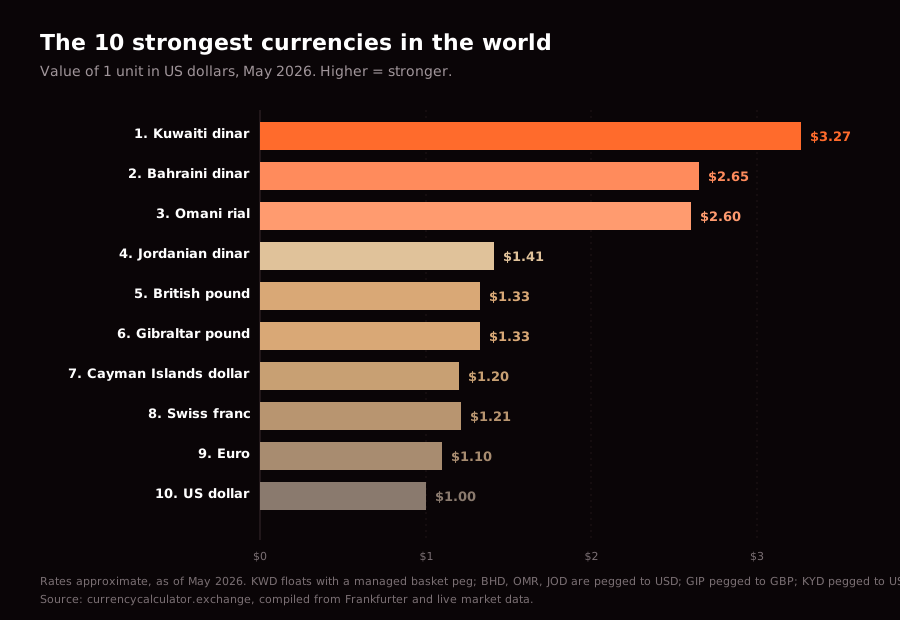
The gap between the top three and the rest is striking. The Kuwaiti dinar, Bahraini dinar, and Omani rial all clear $2.50 to the dollar — roughly twice the value of the British pound. Below them, the rankings tighten considerably.
The top 10, in detail
1. Kuwaiti dinar (KWD) — $3.27
The Kuwaiti dinar has been the world's strongest currency since it was introduced in 1961, when Kuwait broke from the Indian rupee zone. The strength comes from a familiar combination: oil revenue, a small population (just over 4 million), and a sovereign wealth fund — the Kuwait Investment Authority — that is one of the largest in the world, with assets above $800 billion.
Unlike most regional currencies, the dinar isn't pegged to the dollar. It's pegged to an undisclosed basket of currencies, which gives the Central Bank of Kuwait room to manoeuvre when the dollar swings. That basket peg is why the KWD/USD rate moves slightly year to year while the Bahraini dinar barely moves at all.
Outside Kuwait, the dinar is rarely traded. It's a strong currency by value, but a small one by volume.
Country snapshot — Kuwait
- Capital: Kuwait City
- Population: ~4.3 million
- Main language: Arabic (English widely used in business)
- Economy: Oil and petrochemicals (~90% of export revenue)
- Currency in use since: 1961
2. Bahraini dinar (BHD) — $2.65
The Bahraini dinar has been pegged to the US dollar at 1 BHD = $2.659 since 2001. That's not a market price; it's a policy. The Central Bank of Bahrain commits to buying or selling dollars at that rate, which keeps the dinar locked in place.
Bahrain has oil — though less than its Gulf neighbours — and a sizeable financial services sector. Manama, the capital, is one of the region's banking hubs. The peg is sustainable as long as Bahrain's foreign reserves and dollar inflows from oil, gas, and finance keep up with demand. So far, they have, though Bahrain has run noticeable fiscal deficits in recent years that have made some analysts question the long-term peg.
Country snapshot — Bahrain
- Capital: Manama
- Population: ~1.5 million
- Main language: Arabic
- Economy: Oil, banking, finance, aluminium
- Currency pegged to USD since: 2001
3. Omani rial (OMR) — $2.60
The Omani rial has been pegged to the US dollar at 1 OMR = $2.6008 since 1986 — one of the longest-running currency pegs in the world. Forty years, no change.
That stability isn't an accident. The Central Bank of Oman runs a tight monetary policy and holds significant foreign exchange reserves. Oman is also working harder than its Gulf neighbours to diversify away from oil — through Vision 2040, the country is investing in tourism, logistics, manufacturing, and renewable energy. That gives the rial a slightly more sustainable foundation than a pure petro-currency.
Country snapshot — Oman
- Capital: Muscat
- Population: ~4.6 million
- Main language: Arabic
- Economy: Oil and gas, with growing tourism and logistics sectors
- Currency pegged to USD since: 1986
4. Jordanian dinar (JOD) — $1.41
Jordan is the odd one out in the top four. It isn't a major oil exporter. It doesn't sit on Gulf-scale reserves. So why is the dinar this strong?
Two reasons. First, the JOD is pegged to the US dollar at around 1 JOD = $1.41, and Jordan's central bank has held that peg through regional conflict, refugee crises, and global financial shocks. Second, Jordan receives substantial international aid and remittances — both flowing in dollars — that the central bank uses to defend the peg.
It's a strong currency held up by policy and external support rather than commodity exports. That makes it more vulnerable than the Gulf trio, but it's held through every test so far.
Country snapshot — Jordan
- Capital: Amman
- Population: ~11.3 million
- Main language: Arabic
- Economy: Services, tourism, phosphates, remittances, foreign aid
- Currency pegged to USD since: 1995
5. British pound (GBP) — $1.33
The British pound is the strongest freely floating major currency on this list. Everything above it is pegged or tightly managed. The pound moves with markets — and over the last decade it has moved a lot.
The 2016 Brexit vote pushed the pound from $1.50 to $1.20 in days. The 2022 "mini-budget" briefly sent it below $1.10. And yet the pound has clawed back to $1.33 by mid-2026, supported by Bank of England rate policy, the UK's position as a financial centre, and London's deep capital markets.
The pound is also one of the most-traded currencies in the world. GBP/USD — known as "cable" in forex jargon, after the transatlantic telegraph cable that used to carry the rate — is the third or fourth most-traded forex pair globally. It's strong, liquid, and volatile, three things that don't usually go together.
Country snapshot — United Kingdom
- Capital: London
- Population: ~67.7 million
- Main language: English
- Economy: Financial services, manufacturing, tech, creative industries; world's 6th-largest by GDP
- Currency: Pound sterling, in use since the 8th century (modern decimal form since 1971)
6. Gibraltar pound (GIP) — $1.33
The Gibraltar pound is pegged 1:1 with the British pound, which is why it sits exactly where the pound does. It's issued by the Government of Gibraltar, accepted alongside GBP in the territory, and generally not accepted in the UK itself.
Functionally, the GIP is a local variant of sterling. Tourists end up with GIP notes and discover at Heathrow that nobody will take them. That's the one practical thing worth knowing about it.
Country snapshot — Gibraltar
- Status: British Overseas Territory at the southern tip of Spain
- Population: ~32,700
- Main language: English (Spanish widely spoken)
- Economy: Financial services, online gaming, tourism, shipping
- Currency pegged to GBP at parity (1:1)
7. Swiss franc (CHF) — $1.21
The Swiss franc is the only currency in this top 10 with serious global reserve status outside the dollar and euro. It's the world's safe-haven currency — when geopolitics gets messy, investors buy francs. The Swiss National Bank has spent years trying to weaken the franc to protect Swiss exports, with mixed results.
The franc's strength comes from Switzerland's political neutrality, its banking sector, low inflation, and the SNB's careful management of monetary policy. It's the most stable major currency in the world by most measures. The SNB famously broke its euro peg in January 2015, sending CHF up roughly 30% in a single day — a reminder that even managed currencies can move sharply.
Country snapshot — Switzerland
- Capital: Bern (Zürich is the financial hub)
- Population: ~8.8 million
- Main languages: German, French, Italian, Romansh
- Economy: Banking, pharmaceuticals, watches, machinery, chocolate
- Currency: Swiss franc, in use since 1850
8. Cayman Islands dollar (KYD) — $1.20
The Cayman Islands dollar is pegged to the US dollar at 1 KYD = $1.20. The peg has held since 1974, and is backed by the Cayman Islands Monetary Authority.
The Caymans are a major offshore financial centre — hedge funds, captive insurance, structured trusts. Most of that money is denominated in US dollars, not KYD. The local currency is mostly a convenience for residents and tourists. The peg makes it strong on paper; the islands' financial sector makes the peg credible.
Country snapshot — Cayman Islands
- Status: British Overseas Territory in the Caribbean
- Population: ~69,000
- Main language: English
- Economy: Financial services (around 40% of GDP), tourism
- Currency pegged to USD since: 1974
9. Euro (EUR) — $1.10
The euro is the world's second-most-held reserve currency, used by 20 EU member states and several non-EU territories (Andorra, Monaco, San Marino, Vatican City, plus Kosovo and Montenegro unofficially). At around $1.10 to the dollar, it's stronger than the dollar but well below the top of this list.
The euro's strength is institutional. The European Central Bank runs coordinated monetary policy across the eurozone, even though fiscal policy remains national. That tension — one central bank, twenty fiscal regimes — has stress-tested the euro through the 2010-12 sovereign debt crisis, Brexit, and the energy shock of 2022-23. It has survived each time, sometimes uncomfortably.
Region snapshot — Eurozone
- Number of member states using EUR: 20 (of 27 EU members)
- Total population: ~349 million
- Main languages: 24 official EU languages
- Economy: Combined GDP makes the eurozone the world's third-largest economy (after the US and China)
- Currency: Euro, launched as accounting currency in 1999, physical notes/coins in 2002
10. US dollar (USD) — $1.00
And here's the punchline. The world's most important, most traded, most reserved currency is tenth on this list. That seems wrong until you remember what this list measures: face value, nothing else.
The dollar's real power isn't in its face value. It's in the fact that around 88% of all forex trades have a dollar on one side. It's in the fact that oil, gold, and most international commodities are priced in dollars. It's in the dollar's status as the world's primary reserve currency, accounting for around 58% of global central bank holdings. Those are different metrics, and on every single one the dollar wins easily.
A high exchange rate and global influence are not the same thing. The dollar is the most powerful currency in the world. It is not the most valuable.
Country snapshot — United States
- Capital: Washington, D.C.
- Population: ~340 million
- Main language: English
- Economy: World's largest by GDP at over $28 trillion; services-led with major tech, finance, and energy sectors
- Currency: US dollar, in use since 1792
Positions 11–25: the rest of the top 25
These currencies sit just below the top 10 and rotate in and out depending on the week:
| Rank | Currency | Code | Country | 1 unit = USD |
|---|---|---|---|---|
| 11 | Canadian dollar | CAD | Canada | $0.73 |
| 12 | Brunei dollar | BND | Brunei | $0.75 |
| 13 | Singapore dollar | SGD | Singapore | $0.75 |
| 14 | Australian dollar | AUD | Australia | $0.66 |
| 15 | New Zealand dollar | NZD | New Zealand | $0.60 |
| 16 | Bermudan dollar | BMD | Bermuda | $1.00 (pegged) |
| 17 | Bahamian dollar | BSD | Bahamas | $1.00 (pegged) |
| 18 | Panamanian balboa | PAB | Panama | $1.00 (pegged) |
| 19 | Aruban florin | AWG | Aruba | $0.56 |
| 20 | Libyan dinar | LYD | Libya | $0.21 |
| 21 | Saudi riyal | SAR | Saudi Arabia | $0.27 |
| 22 | Qatari rial | QAR | Qatar | $0.27 |
| 23 | UAE dirham | AED | UAE | $0.27 |
| 24 | Falkland Islands pound | FKP | Falkland Islands | $1.33 (pegged to GBP) |
| 25 | Hong Kong dollar | HKD | Hong Kong | $0.13 |
A note on the table above: several of these — Bermudan dollar, Bahamian dollar, Panamanian balboa, Falkland Islands pound — appear in the top 25 because of where they're pegged rather than where they trade independently. The Saudi riyal, Qatari rial, and UAE dirham are all also dollar-pegged but at lower rates. Whether a peg counts as "strength" is a philosophical question; this list includes them because most other ranking lists do.
Why high value doesn't mean powerful
This is the section most lists skip. It's worth understanding properly.
A currency's value is set by supply and demand or by a fixed peg. A small country with a huge oil surplus and a tightly managed currency can produce a very high exchange rate — that's the Kuwait story. But that high rate doesn't mean anyone uses the dinar outside Kuwait.
A currency's power is something different. It's measured by:
- Reserve share — what percentage of central bank holdings worldwide are in that currency. USD: ~58%. EUR: ~20%. JPY: ~5%. GBP: ~5%. Everything else: rounding errors. The Kuwaiti dinar isn't a meaningful reserve currency.
- Trade share — what share of international trade is invoiced in that currency. USD dominates here too, especially in commodities like oil, gold, and most agricultural goods.
- Forex turnover — the BIS Triennial Survey measures daily forex trading volume. The dollar is on one side of around 88% of all trades. The euro is on 31%. The yen, 17%. The Kuwaiti dinar is too small to register at survey scale.
- SWIFT messaging share — what percentage of cross-border payment messages use each currency. The dollar leads here too, though the euro is closer behind in this metric than in others.
By those measures, the dollar is unquestionably the most powerful currency on Earth. The Kuwaiti dinar is the most valuable. These are different questions with different answers, and most "strongest currency" lists conflate them.
Strongest vs most traded vs most stable vs most powerful
A quick taxonomy for the four ways currencies get compared:
Strongest by value: Kuwaiti dinar (KWD). Then BHD, OMR, JOD, GBP.
Most traded: US dollar (USD). Then EUR, JPY, GBP, CNY. Together these five make up the vast majority of daily forex turnover globally.
Most stable (lowest volatility): Swiss franc (CHF) historically holds the title among floating currencies. Pegged currencies are technically more stable against their reference currencies, but that's a policy outcome rather than a market one.
Most powerful (reserve + trade + influence): US dollar, by a wide margin. The euro is second; nothing else is close.
Pick the metric that matches your question. If you're a tourist wondering why your dollars buy so few dinars in Kuwait, "strongest by value" is the answer. If you're a treasurer thinking about FX risk, stability matters more. If you're an economist thinking about global influence, reserve and trade share are the right lens. If you're a forex trader, liquidity and turnover trump everything.
Want to check a real exchange rate? Use our free currency converter — it pulls live rates at the mid-market price (the rate banks and providers benchmark against) with no markup. Useful for everything from holiday spending to comparing what your bank actually charged you against the real rate.
FAQs
Which is the strongest currency in the world in 2026?
The Kuwaiti dinar (KWD) is the strongest currency in the world by exchange rate, worth approximately $3.27 in May 2026. It has held the top spot since it was introduced in 1961, supported by Kuwait's oil reserves, a small population, and a managed currency peg against an undisclosed basket of currencies.
Why is the Kuwaiti dinar so strong?
Three main reasons. First, Kuwait has one of the largest oil reserves per capita in the world, which generates substantial foreign currency inflows. Second, Kuwait's population is small (around 4.3 million), so wealth per person is high. Third, the Central Bank of Kuwait manages the dinar against a basket of currencies rather than letting it float freely, which keeps the rate stable and high. The dinar's strength reflects Kuwait's policy choices as much as its economic fundamentals.
Is the strongest currency the same as the most powerful currency?
No. "Strongest" usually refers to face value — how many US dollars one unit buys. "Most powerful" refers to global influence, reserve status, and trading volume. The Kuwaiti dinar is the strongest by value, but the US dollar is the most powerful by every measure of global use. The dollar appears on one side of about 88% of all forex trades and accounts for around 58% of global central bank reserves. The Kuwaiti dinar accounts for almost none of either.
Why is the US dollar only number 10 on this list?
Because this list ranks by exchange rate, and the dollar is the reference currency. By definition, $1 USD equals $1.00. Currencies that are pegged higher (like the dinars and rials at the top) or trade higher (like the pound and Swiss franc) all rank above it. But the dollar's importance to the global economy comes from its trading volume, reserve status, and use in commodity pricing — none of which the exchange rate captures.
Which currency is the most stable?
The Swiss franc (CHF) is widely considered the most stable major floating currency. The Swiss National Bank manages it carefully, Switzerland has low inflation and political neutrality, and the franc is the world's go-to safe-haven currency during global crises. Pegged currencies like the Bahraini and Omani dinars and the Hong Kong dollar are technically more "stable" against their reference currencies, but that's a policy outcome rather than a market one.
How are pegged currencies different from floating currencies?
A floating currency moves based on market supply and demand — the British pound, Swiss franc, Japanese yen, and US dollar all float. A pegged currency is fixed to another currency or basket at a specific rate, with the central bank intervening to maintain that rate. Six of the top 10 strongest currencies are pegged, which is part of why they appear at the top — the peg locks in a high rate. Pegs can hold for decades (the Omani rial since 1986) or break under pressure (the Swiss franc's January 2015 break from its euro peg).
What is the most traded currency in the world?
The US dollar is the most traded currency by a wide margin, appearing on one side of around 88% of all forex transactions according to the BIS Triennial Survey. The euro is second at around 31%, followed by the Japanese yen (17%), British pound (13%), and Chinese yuan (7%). Forex percentages add up to 200% because each trade involves two currencies.
What is the strongest currency pair?
The most traded currency pair globally is EUR/USD (euro/US dollar), accounting for roughly 23% of all forex turnover. The next most-traded pairs are USD/JPY, GBP/USD ("cable"), and USD/CNY. "Strongest" in this context usually means most-traded and most-liquid rather than highest-priced — these are the pairs with the tightest spreads and deepest liquidity.
What is the weakest currency in the world?
As of May 2026, the Iranian rial (IRR) remains the world's weakest currency, with an official exchange rate of roughly 42,000 rial to the US dollar — and a market rate that's far weaker still. Other very weak currencies include the Vietnamese dong, Sierra Leonean leone, and Indonesian rupiah, though weakness in these cases mostly reflects historical denomination choices rather than current economic distress.
In what country is GBP worth the most?
The British pound's purchasing power varies hugely across the world. Pound-strong destinations in 2026 include Turkey, Argentina, Pakistan, Vietnam, and parts of Eastern Europe — places where the pound buys significantly more in local goods and services than it would at home. Exchange rate alone isn't the full picture; cost of living also matters. A pound that converts to a lot of Vietnamese dong still buys roughly the same coffee in Hanoi that £4 buys in London, because the local price level is correspondingly lower.
Which countries use the Kuwaiti dinar?
Only Kuwait. The dinar is the sole legal tender of Kuwait and isn't shared with any other country. It can be exchanged in some neighbouring Gulf states and at major international currency exchanges, but it's not in active circulation anywhere else.
Should you care about a currency's strength?
For most everyday purposes — sending money abroad, paying for a holiday, buying imported goods — what matters isn't the face value of the currency. It's the change in the exchange rate between when you bought and when you used the money, and the spread your bank or card takes on top of the mid-market rate.
A "strong" currency isn't automatically a good one to hold. The Swiss franc has been a brilliant store of value over the past two decades, but Swiss savers have earned almost zero interest on their deposits for most of that time. The dollar is "weaker" by face value than half of this list, but US Treasury bonds are the bedrock of global finance and pay a meaningful yield.
If you're moving money across borders, the question that actually matters is: what rate are you getting, and what's the spread? Mid-market rate is the benchmark — that's the rate currencies trade against each other on the wholesale market. Anything you pay above that is a spread, and spreads are where banks and providers make their money.
Check the mid-market rate on any currency pair before you transfer, then compare against what your bank or provider is offering. The difference is what the transaction is actually costing you — and that matters a lot more than which currency tops some list.
Related reading: Looking for the other end of the spectrum? We're working on a guide to the world's weakest currencies — coming soon.
Exchange rates in this guide are approximate, sourced from Frankfurter and live market data as of May 2026. Rates fluctuate constantly; always check current rates before making decisions based on currency values.
Sources:
- Bank for International Settlements — Triennial Central Bank Survey, latest edition
- International Monetary Fund — Currency Composition of Official Foreign Exchange Reserves (COFER)
- Central Bank of Kuwait — monetary policy and exchange rate framework
- Central Bank of Bahrain — fixed exchange rate policy
- Central Bank of Oman — exchange rate arrangements
- Swiss National Bank — monetary policy statements
- European Central Bank — euro area data
- Frankfurter — open-source FX rate API